
Top 7 AI Tools in Healthcare for 2026: Smarter Medicine Starts Here

Medical history has entered a period of extraordinary transformation, which stands as one of its most fascinating times. Research labs and tech conferences used to be the only places where AI in healthcare existed, but now hospitals, clinics, pharmacies, and smartphones use this technology. The tools from 2026 bring healthcare systems to new levels of…
Zannatun Nime
Medical history has entered a period of extraordinary transformation, which stands as one of its most fascinating times.
Research labs and tech conferences used to be the only places where AI in healthcare existed, but now hospitals, clinics, pharmacies, and smartphones use this technology.
The tools from 2026 bring healthcare systems to new levels of performance. The medical field has launched a complete overhaul, which will transform healthcare delivery for all times to come. But with so many platforms flooding the market, it can be overwhelming to know which AI tools actually deliver results.
That is exactly why we put together this guide. This blog article presents seven different healthcare AI tools that deliver substantial impact throughout the year 2026 by assisting with drug development and disease analysis, clinical record maintenance, and stroke identification.
The three tools function independently to solve independent problems, but they demonstrate how artificial intelligence will transform medical care in the future. Let us get into top AI Tools in Healthcare.
What Is Driving the AI in Healthcare Revolution?
The tools remain unknown to us because we lack an understanding of the medical environment, which pushes artificial intelligence systems to operate across all healthcare areas.
The worldwide healthcare network faces an urgent crisis that threatens to damage its operational framework.
The healthcare system faces an intense crisis because four major challenges have emerged, which include an aging population and increasing chronic disease cases, insufficient medical specialists, and excessive amounts of unstructured information. The current systems lack the ability to handle this situation.
Healthcare systems experience their first chance at survival because AI technology delivers three vital capabilities, which it performs at its best.
First, it processes enormous volumes of data from genomic sequences to medical imaging at speeds no human team could match. The system detects patterns along with risk indicators, which remain hidden from human vision.
The system performs two main functions, which include automating repetitive clinical work and administrative tasks that take up a lot of time, so that medical personnel can dedicate their time to essential work.
The healthcare system produces results that combine fast service with exact results that deliver personalized care while maintaining a human touch because medical staff members now have additional time and improved access to information.
The following AI tools will dominate the market throughout 2026.
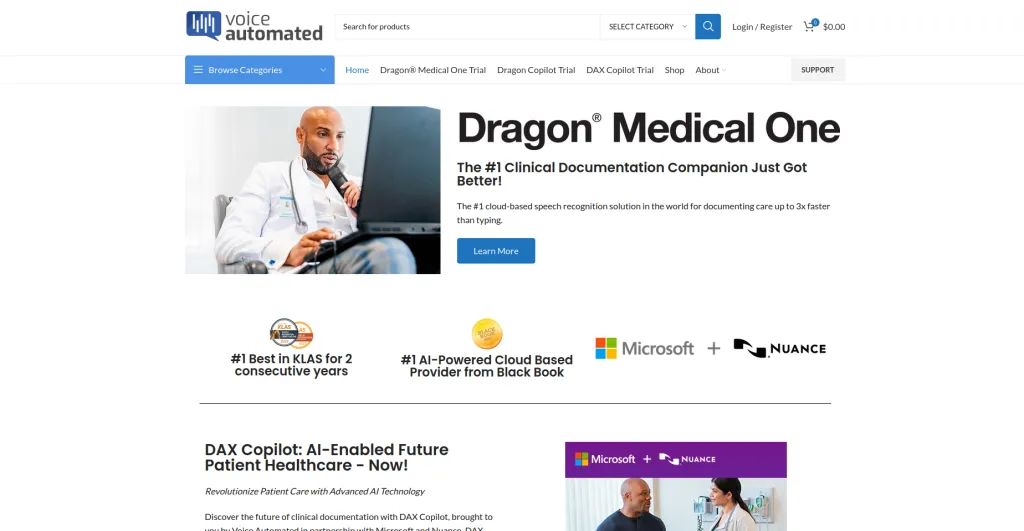
1. Nuance DAX Copilot — AI-Powered Ambient Clinical Documentation
Category: Clinical Documentation
Developed by: Microsoft Nuance
What It Does
Nuance DAX Copilot stands as a top healthcare AI tool that has gained widespread attention throughout the medical field.
It functions as an ambient AI scribe that operates in the background during patient visits to generate complete clinical notes through its automatic note creation system.
Doctors maintain their natural conversation style when they interact with patients. DAX Copilot handles everything else.
The doctor reviews the notes before finalizing their transfer into the EHR system through a straightforward process.
Why It Matters
Physician burnout has developed into a major healthcare emergency that requires immediate attention. Research studies have established that doctors need to document patient information for about two hours for each one hour they spend with their patients.
DAX Copilot directly attacks this problem, giving doctors back hours of their day and letting them be fully present with their patients rather than staring at a screen.
Who It Is For
Medical doctors who practice primary care and specialists and any healthcare facility which needs to manage a large number of patient records.
Standout Feature
Its deep integration with Microsoft Azure and Epic EHR makes rollout seamless for large health systems.
Pricing
Custom enterprise pricing. Contact Nuance directly for a quote.
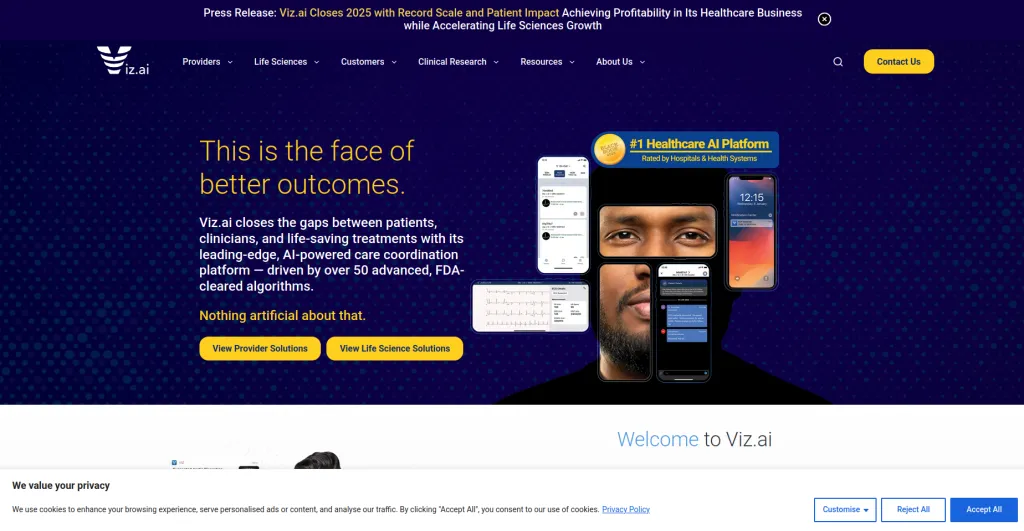
2. Viz.ai — AI for Stroke and Critical Care Detection
Category: Medical Imaging & Emergency Care
Developed by: Viz.ai Inc.
What It Does
Viz.ai uses artificial intelligence to analyze CT scans in real time and instantly alert the appropriate care team when a stroke or other critical condition is detected.
The system identifies large vessel occlusion strokes, which represent the most dangerous stroke type, so it enables neurologists, radiologists, and interventional teams to start treatment within minutes of detection.
Why It Matters
Medical evidence demonstrates that the brain tissue continues to deteriorate at an increasing rate when stroke patients remain without treatment because “time is brain” serves as a medical principle rather than a motivational phrase. Every minute of delay costs neurons.
The platform that Viz.ai provides enables healthcare providers to start treatment faster than any time in history, which results in saved lives and prevents people from losing their ability to function.
Who It Is For
Emergency departments, stroke centers, neurology teams, and radiology departments in hospital settings.
Standout Feature
Its coordinated care notification system connects the entire treatment team simultaneously rather than sequentially, eliminating the chain-of-calls delays that cost critical minutes.
Pricing
Custom institutional pricing based on hospital size and usage.
3. Tempus AI — Precision Medicine and Oncology Intelligence
Category: Precision Medicine / Oncology
Developed by: Tempus Labs
What It Does
Tempus AI operates a huge database of clinical information, together with molecular data which enables oncologists to develop better cancer treatment plans through personalized approaches.
The system lets doctors find proper cancer treatments by analyzing patient genomic data together with an extensive database that contains actual clinical results.
The system contains clinical trial matching functionality, which enables patients to find suitable clinical trials that they probably would not discover on their own.
Why It Matters
Cancer consists of numerous separate diseases that exist under the same name. A breast cancer treatment that proves effective for one patient becomes useless when doctors try the same approach on another patient who has breast cancer but different genetic characteristics.
The system provides precision oncology to all medical centers instead of limiting its access to academic medical centers, which serve as elite institutions.
Who It Is For
Oncologists, cancer centers, genomics labs, and health systems focused on value-based cancer care.
Standout Feature
The real-world evidence engine of the system learns from every new clinical data point which it analyzes to generate better recommendations through its continuous learning process.
Pricing
Custom pricing based on institutional partnership and data volume.
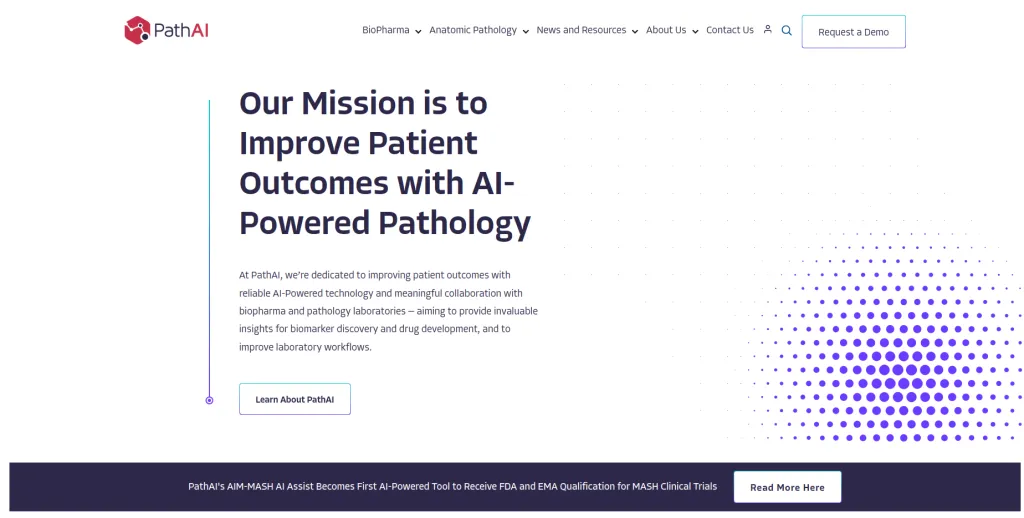
4. PathAI — Artificial Intelligence for Pathology
Category: Diagnostic Pathology
Developed by: PathAI Inc.
What It Does
Path AI, Medical diagnosis of cancer and severe diseases depends on the microscopic examination of tissue samples, which pathologists perform.
The healthcare industry uses PathAI to bring artificial intelligence into pathology laboratories through its deep learning system, which analyzes tissue slides with exceptional accuracy.
The platform enables pathologists to identify cancer cells while they perform tumor grading and biomarker detection for treatment guidance through a system that delivers faster results than human analysis could achieve.
Why It Matters
The medical field of pathology demands two distinct abilities from its practitioners because doctors who examine identical slides will sometimes reach different diagnoses.
PathAI minimizes diagnostic differences between pathologists while it standardizes diagnostic results and speeds up the process which leads from biopsy to final diagnosis. Cancer patients need their test results to arrive quickly because the waiting period becomes an unbearable experience for them.
Who It Is For
Hospital pathology departments, oncology centers, pharmaceutical research teams, and biotech companies running clinical trials.
Standout Feature
The system enables the identification of predictive biomarkers that help doctors find targeted therapies and immunotherapies for patients during precision oncology treatment.
Pricing
Enterprise and research partnerships. Custom pricing available.
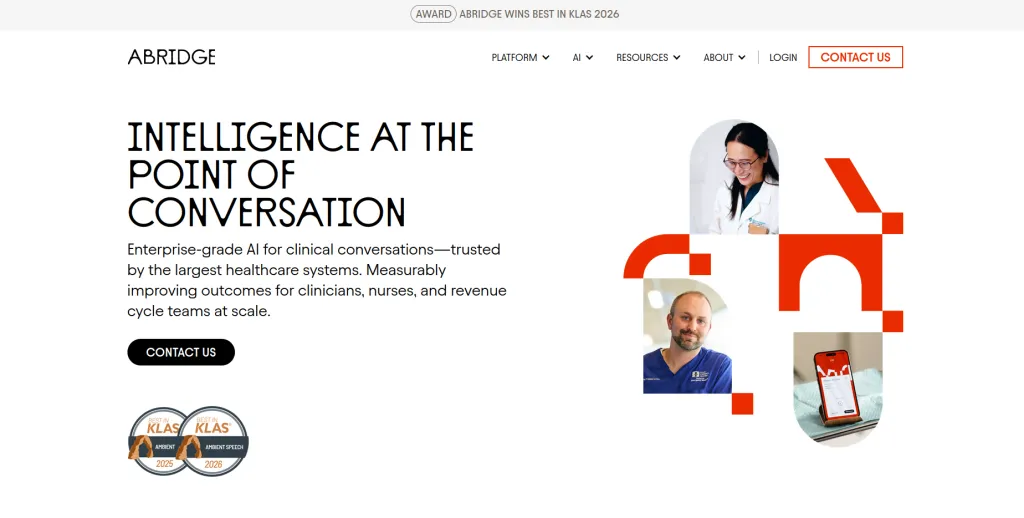
5. Abridge — Real-Time AI Medical Conversation Summarization
Category: Clinical Communication & Documentation
Developed by: Abridge AI (in partnership with UPMC)
What It Does
Abridge functions as a healthcare AI system that records medical discussions between doctors and patients while producing written versions and condensed summaries of these conversations.
Abridge functions as a medical transcription system that creates clinical summaries from spoken conversations by extracting information about symptoms and diagnoses, medication details and follow-up care instructions.
Patients can also access their own visit summaries, helping them understand and remember what was discussed during their appointment.
Why It Matters
Poor communication is one of the leading causes of medical errors and patient non-compliance. When patients leave an appointment without clearly understanding their diagnosis or treatment plan, outcomes suffer.
Abridge tackles this from both sides, reducing documentation burden for clinicians while improving clarity and engagement for patients.
Who It Is For
Hospitals, outpatient clinics, and any care setting focused on improving both clinician efficiency and patient experience.
Standout Feature
The patient-facing visit summary is a genuinely innovative feature that puts AI in healthcare directly in the hands of the people receiving care.
Pricing
Available through institutional agreements. Piloted widely across large U.S. health systems.
6. Insilico Medicine — AI-Driven Drug Discovery
Category: Pharmaceutical Research & Drug Development
Developed by: Insilico Medicine
What It Does
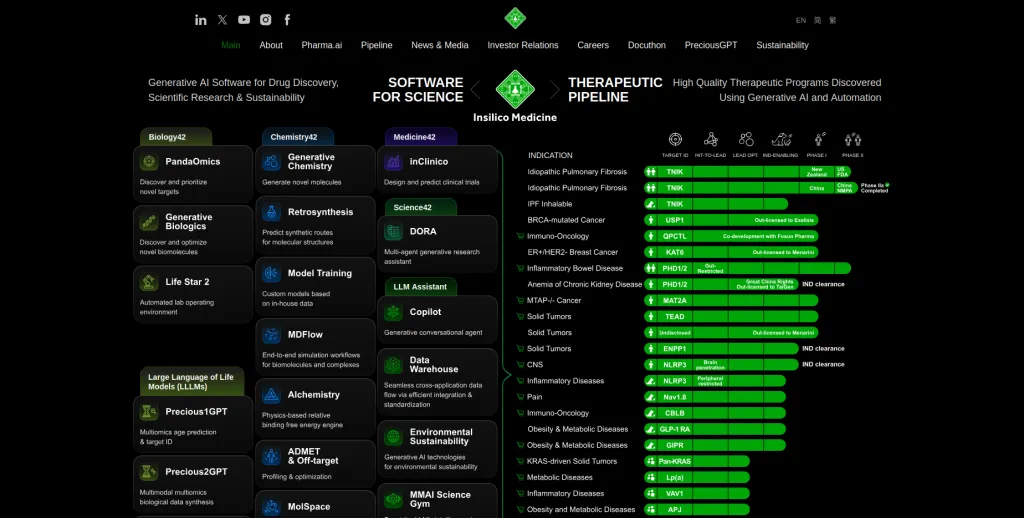
Insilico Medicine is using AI in healthcare to dramatically compress that timeline.
Its platform uses generative AI and deep learning to identify disease targets, design novel drug molecules, and predict how those molecules will behave in the human body, all before a single lab experiment begins.
In 2024, Insilico’s AI-discovered drug candidate for idiopathic pulmonary fibrosis entered Phase II clinical trials, a landmark moment for AI-generated medicine.
Why It Matters
The pharmaceutical industry operates at the highest levels of both financial risk and operational costs, which makes it an expensive business to run. The majority of drugs that enter clinical trials do not succeed in the process.
Insilico’s AI system enhances drug discovery success rates because it removes unpromising candidates during the first stage, and it identifies the most valuable drug candidates while it uncovers new therapeutic possibilities that scientists would have missed.
Who It Is For
The system serves pharmaceutical companies, biotech firms and academic research institutions that focus on drug development pipelines.
Standout Feature
The platform provides a single system that unites generative biology operations from target discovery to molecule creation and preclinical assessment through its integrated platform, which very few systems in the world possess.
Pricing
Research and enterprise partnerships. Custom pricing based on project scope.
7. Olive AI — Healthcare Operations Automation
Category: Healthcare Administration & Operations
Developed by: Olive AI Inc.
What It Does
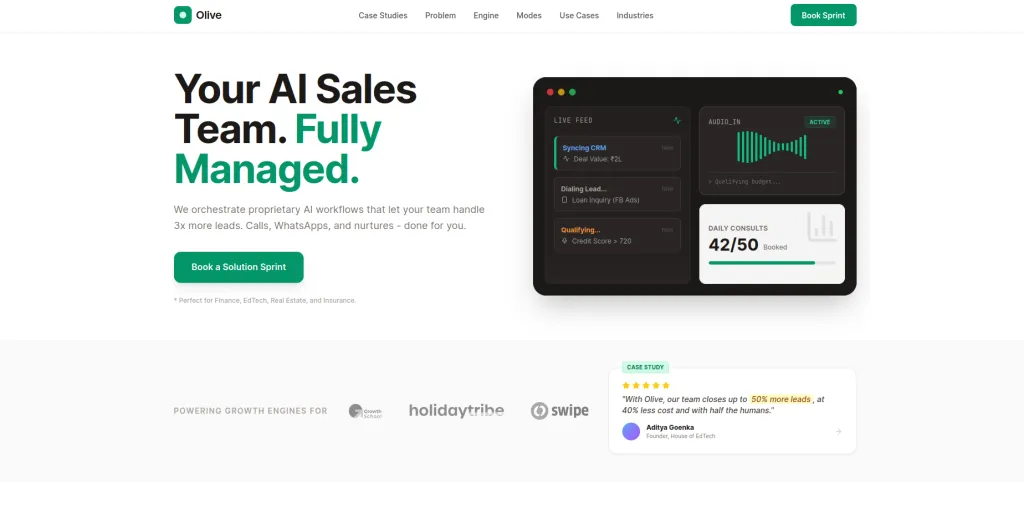
Olive AI operates as an intelligent automation system that exists to support healthcare operational functions.
The system connects various hospital networks while it performs automated administrative tasks ,and it detects operational problems that result in time and financial losses for medical institutions.
Why It Matters
The United States healthcare system spends about 35% of its total expenses on administrative operations. The system requires such an enormous amount of money and energy to handle documentation because it prevents medical workers from focusing on their patients.
Olive solves this problem because it provides automated solutions that handle healthcare organization workflows that waste their resources and their management team’s time.
Who It Is For
Hospital administrators, revenue cycle teams, health system operations leaders, and insurance coordination departments.
Standout Feature
Olive functions with various hospital software systems, which remain operational without needing hospitals to remove their existing technology systems.
Pricing
Custom enterprise pricing based on workflow scope and organization size.
Quick Comparison: All 7 Tools at a Glance
| Tool | Best For | Key Strength | Pricing |
|---|---|---|---|
| Nuance DAX Copilot | Documentation | Ambient AI note-taking | Custom |
| Viz.ai | Emergency Care | Real-time stroke detection | Custom |
| Tempus AI | Oncology | Genomic precision medicine | Custom |
| PathAI | Pathology | AI tissue analysis | Custom |
| Abridge | Clinical Communication | Patient + clinician summaries | Custom |
| Insilico Medicine | Drug Discovery | Generative AI molecule design | Custom |
| Olive AI | Operations | Admin workflow automation | Custom |
How to Choose the Right AI Healthcare Tool for Your Organization
You have so many great options, but you need to choose based on your particular requirements. The framework that follows will help you make decisions.
Start with your biggest pain point. Medical staff need to find solutions to their documentation issues through Nuance DAX Copilot and Abridge. The hospital receives emergency imaging at high volumes so Viz.ai becomes an ideal solution for their needs. Cancer centers need to select between Tempus AI and PathAI because these two solutions will create the most substantial results.
Consider integration requirements. Your current EHR system and imaging technology infrastructure will determine the actual value of any AI solution that you want to implement. Organizations should evaluate their integration capabilities before they decide to commit.
Think about scale. Some of these tools are built for large health systems with enterprise budgets. Others are more accessible for mid-sized clinics. Match the platform to your organizational scale.
Your clinical staff needs to participate from the start. Healthcare organizations achieve success with AI in healthcare when their users develop trust in the system and acquire sufficient knowledge to operate it. The staff needs to support the process from beginning to end because their involvement will bring success to the adoption process.
Conclusion
The healthcare sector will experience various AI applications, which will affect all medical domains throughout 2026.
Artificial intelligence stands as the essential medical tool that healthcare needs because it performs three vital functions, which include ambient AI for clinical note creation, neural network stroke detection, and generative model drug development.
The seven tools in this guide represent some of the most impactful examples of what AI can do when it is built thoughtfully, deployed responsibly, and focused on a clear clinical or operational problem.
None of them replaces the human judgment, empathy, and expertise at the heart of great healthcare. Instead, they amplify it.
Healthcare organizations that want to progress need to decide ton heir first AI implementation projects instead of thinking about AI adoption.
The future of AI in healthcare is already here. The only decision left is how quickly you choose to embrace it.

Written by
Zannatun Nime
February 24, 2026
Zannatun Nime writes about AI, developer tools, and social media marketing in a simple and easy-to-follow way. He enjoys making complex topics clear, practical, and useful for everyday readers.
Related reading

RESOURCES
Best Booking Plugins for WordPress in 2026 – Top Picks for Service Businesses
Discover the best booking plugins for WordPress in 2026. Honest pros, cons & pricing for every top tool. GemBooking leads the list for service businesses.

RESOURCES
Best WordPress Automation Plugins for 2026 (Complete Guide)
You didn't build a WordPress site to spend your days copying form entries into spreadsheets, manually emailing customers after every purchase, or chasing down the same tasks every single week. That gap between what WordPress can do and what it does automatically? That's where most site owners bleed time.

RESOURCES
Best Custom Post Type Plugins for WordPress in 2026 (Free & Pro)
You built your WordPress site. Posts and pages are live. Then your client asks: Can we add a Testimonials section? A Jobs board? A Portfolio gallery? This is where custom post type plugins save you.